Where delegated agents actually do the work.
Agent Fleet is the execution layer beneath Agent Anything. When work is delegated to an agent, Agent Fleet gives that agent its own isolated environment with its own files, tools, model route, and limits, so the work can run safely and pick up where it left off.
Models can change. The workplace remains.
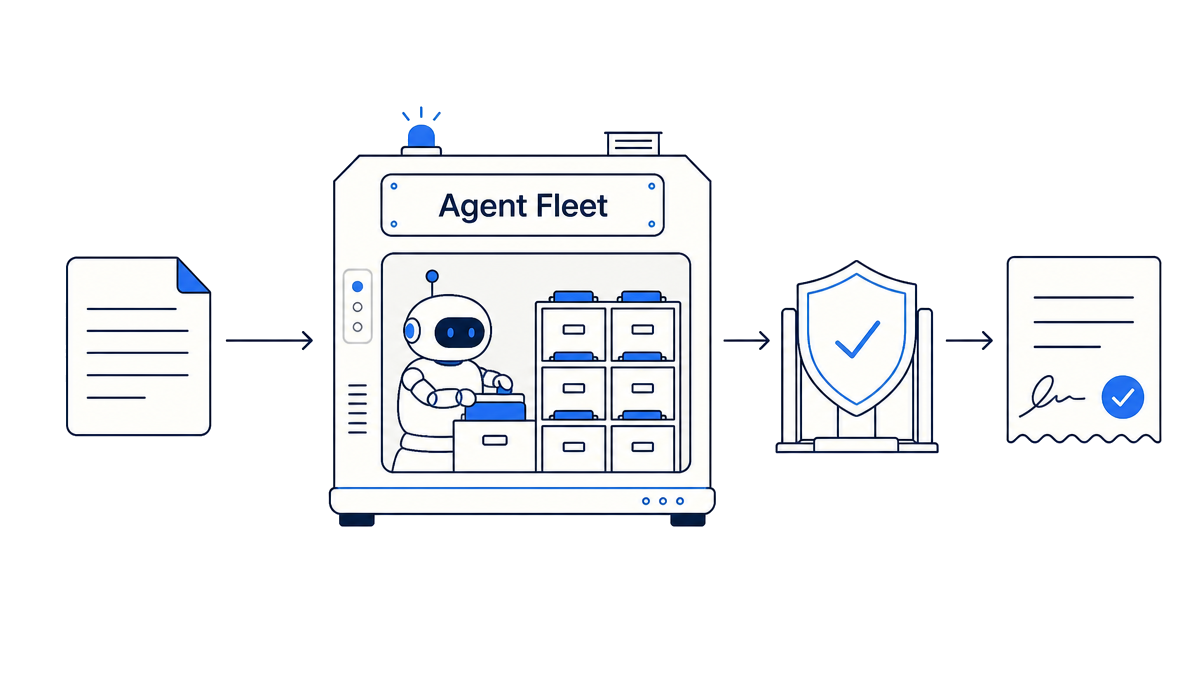
How it fits together.
People work in Agent Anything.
Work that needs its own environment lives in an Attexa Arc workspace.
Agent Fleet is what runs underneath both when an agent is doing the work. Most customers never configure it directly.
Four jobs, four layers.
Reaching a model and doing the work are different jobs. Each layer owns one of them.
Agent Anything
The people-facing platform. Private assistants, shared memory, delegated work, approvals, and evidence.
Agent Fleet
The workspace an agent runs in. Isolated, persistent, and limited to the access it was given.
Model routing
Which model answers each step, from which provider, over which route.
Attexa
What happens when an agent tries to change something real. Policy at the boundary, a person when required, evidence afterward.
What each agent gets.
Its own environment
One agent's work cannot touch another's. Each active worker runs in a bounded environment of its own rather than sharing a general-purpose process with everything else in the organization.
Work that persists
Files, installed tools, and progress survive between runs, model changes, and restarts. The next session continues from the state already built instead of starting over.
Access decided by you
The model route, network reach, data, tools, spend limits, and publishing rights are assigned by the organization. An agent never grants itself more room to operate.
Visible while it runs
Assignments, progress, runtime posture, output, and cost are observable as the work happens. Consequential actions are separately approved and receipted by Attexa.
What happens when work is delegated.
- 01
Commission
Someone describes the outcome in plain language. Example: reconcile last quarter's vendor invoices against the contract terms.
- 02
Work
Agent Fleet opens an isolated workspace and the agent gathers the invoices, loads the contracts, and works through them.
- 03
Decide
The agent reaches a conclusion and proposes what should happen next.
- 04
Authorize
Attexa checks the proposed action against policy and asks a person to approve it when the rules require one.
- 05
Act
The approved change is made in the connected system.
- 06
Prove
Attexa Witness issues a signed receipt anyone can verify independently.
- 07
Preserve
The workspace, the results, and the evidence stay available for the next round of work.
You choose which models are allowed in.
The organization decides which intelligence is allowed into the work, and Agent Fleet applies that decision at the route level.
- Commercial frontier models
- Multiple inference providers
- Privately hosted models
- Attested confidential inference routes
- Future regional or customer-operated inference
Models run wherever your organization approves. What stays constant is your control over the environment, the route, the boundaries, and everything the work leaves behind.
What this looks like in practice.
A research effort that runs for months
Sources, code, notes, and generated artifacts stay in one workspace, so each round of analysis builds on the last instead of starting from an empty context.
A software delivery task
The worker clones the repository, installs dependencies, writes and tests code, and produces artifacts. It can return next week to a workspace that is still set up.
A matter involving several parties
Agents acting for different people or organizations contribute to one bounded workspace, while publication, disclosure, and official record changes stay under separate approval.
How it fits.
Agent Anything stays the front door, organizing people, context, and delegated work. Agent Fleet is the workshop behind it, giving each delegated agent an isolated, durable place to work, and customers experience that through Attexa Arc. Attexa governs consequential actions and produces evidence anyone can verify independently.
Bring us one thing you'd like to make easier.
We'll help you find a useful place to start, shape the setup around your team, and show you how to carry it forward.