A shared mind the organization owns.
Your team learns useful things every day. The Thinktank keeps the work outputs people choose to share, so teammates and their assistants can find them and build on them.
What the Thinktank is.
It is the organization's shared memory: a place where decisions, context, and hard-won judgment collect over time, in the words of the people who produced them. It grows one approved contribution at a time. It never listens in the background. It belongs to the organization, not the vendor.
- 01
Your assistant notices what's worth keeping
Working alongside you, it spots a decision, a pattern, or a piece of context the team would benefit from.
- 02
You approve the exact contribution
Your assistant offers a short work output. You see the exact text. Edit it, discard it, or publish it. Nothing moves without your yes.
- 03
The organization remembers
Your approved work output enters the shared memory attributed to you, and from that moment on every teammate's assistant can draw on it by name.
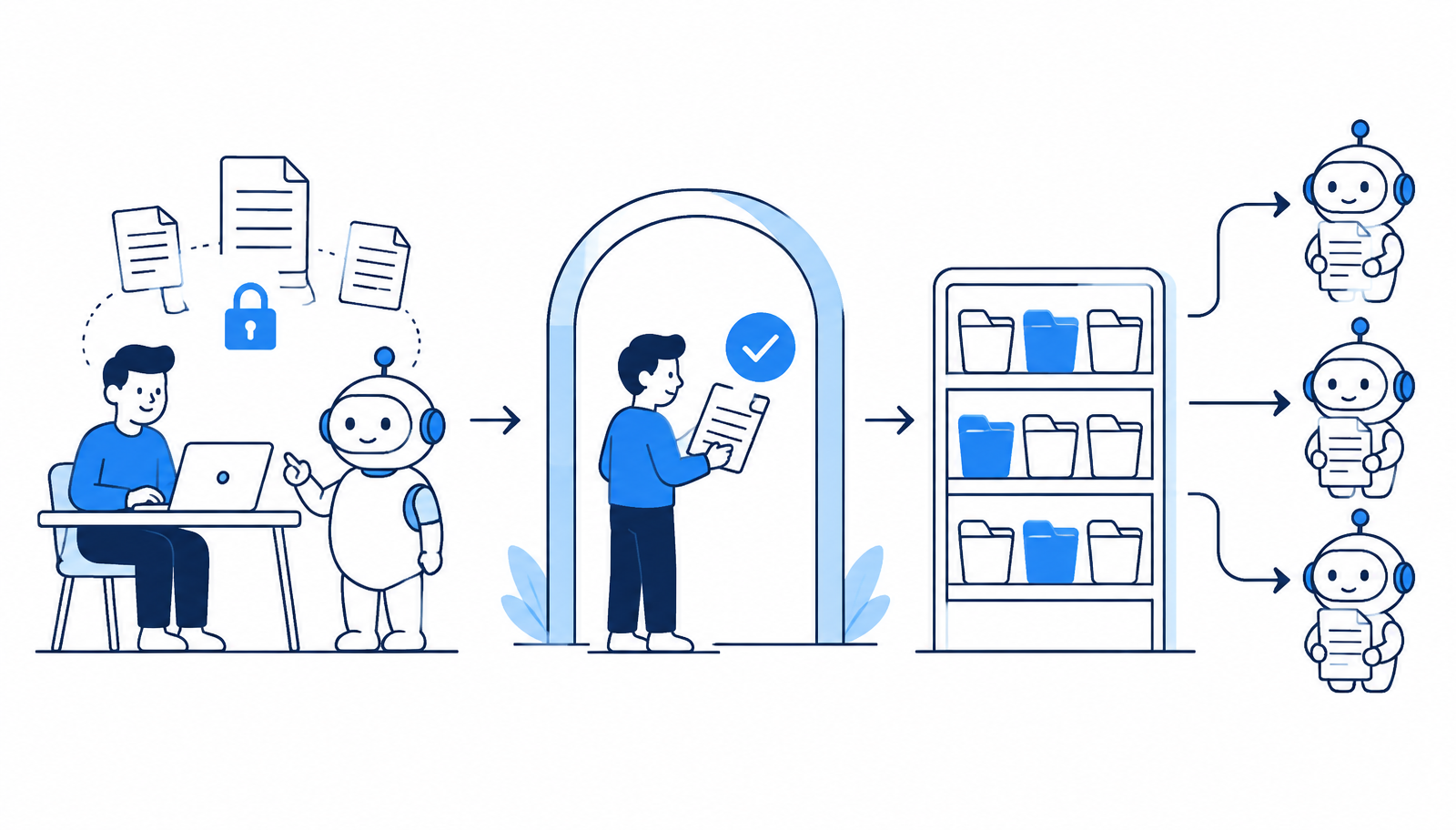
The Thinktank sits at the center of a loop that turns everyday work into reusable organizational knowledge.
The shared memory is human-gated.
Nothing is shared without your consent
Never a whole conversation. Never a background summary. Only the work output you approved, in the exact words you approved.
A person is always in the loop
Assistants draft. People decide. The organization only remembers what someone chose to share.
AI cannot write to the shared memory
An assistant may suggest, summarize, or rephrase, but only a person can commit a contribution to the Thinktank.
How it differs from search or docs.
Search finds what was already written. A document is a snapshot someone has to maintain. The Thinktank is a living memory connected to ongoing work: every contribution arrives with its author, its context, and the authority behind it, and assistants can cite it while a conversation is still happening.
Because it is built from deliberate contributions rather than scraped transcripts, the answers it produces are traceable. You can ask where a finding came from, who stands behind it, and what conversation produced it.
What gets remembered.
Any piece of work a person chooses to contribute can become part of the shared memory. The most valuable contributions tend to fall into a few categories.
Decisions and constraints
Why a choice was made, what was ruled out, and what boundary still applies.
Findings and patterns
Research results, recurring causes, and lessons that show up across projects.
Authority and exceptions
Policy exceptions, approved model routes, and the reasoning behind them.
Hard-won judgment
The context and caveats that make a conclusion useful months later.
Recall in action.
When a teammate asks their assistant a related question, it can draw from the Thinktank and name the person behind the contribution. The answer is not a generic summary: it is a specific finding, with a source, that the team can trust and question.
Over time, the shared memory becomes more useful the more it is used. A decision recorded this quarter explains a constraint someone runs into next year. A researcher's finding reaches a colleague who never met them, with the author's name attached.
Build a memory your team can trust.
We can map your current knowledge surfaces and identify the first work outputs worth turning into shared memory.